B-Cell Signaling and Functional Plasticity in CLL
 Christine LE-ROY
Research Officer
Christine LE-ROY
Research Officer
B-Cell Signaling and Functional Plasticity in CLL Principal Investigator: Christine Le Roy (PhD, HDR) Group Leader – Axis 1
Research Overview
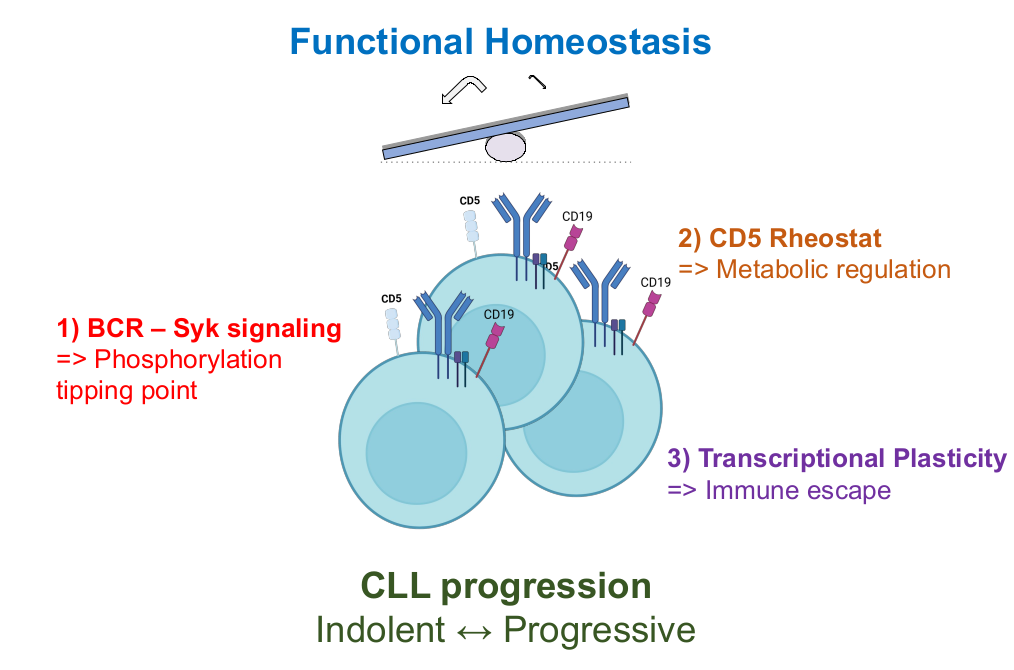
Our research focuses on Chronic Lymphocytic Leukemia (CLL), a highly heterogeneous disease where clinical outcome remains difficult to predict. While IGHV mutational status is a standard prognostic factor, its predictive value is not absolute. Our group investigates the intrinsic characteristics of tumor B cells, with a particular focus on the BCR signalosome, to identify new stratification markers and therapeutic targets. Based on our published data, we hypothesize that the clinical progression of CLL is driven by a disruption of key functional balances (homeostasis) within the tumor cells, favoring survival, tissue retention, and immune evasion.
Current Research Focus
Our group is currently exploring three major axes to determine the “tipping points” that lead to disease progression:
- The BCR Signalosome & Syk Kinase: We investigate the role of the signalosome in CLL heterogeneity. Our central question is whether Syk activation acts as a functional tipping point between Responders (progressive) and Non-Responders (indolent) patients. We are currently identifying differential phosphorylation signatures of Syk to predict patient trajectories better.
- CD5 as a metabolic Rheostat: We study how the heterogeneous expression of CD5 modulates the BCR activation threshold. Our data shows that CD5 impacts the metabolic activity and the secretome of tumor cells. By comparing CD5low and CD5high subpopulations, we aim to understand how CD5 acts as a “rheostat,” regulating cellular survival and long-term persistence.
- Transcriptional Plasticity & Immune Evasion: We explore the capacity of tumor B cells to acquire a regulatory phenotype (Breg-like). We are specifically investigating how the co-expression of FOXP3 and TGFβ1, regulated by specific transcription factors, facilitates tumor escape and cellular dormancy, leading to treatment resistance and relapse.
Strategic Vision & Development We are committed to a translational research model that seamlessly connects molecular discovery to patient care. This approach is anchored by our close integration with the Hematology and Biochemistry departments at Avicenne Hospital, allowing us to transform fundamental findings into clinical realities. Since 2009, we have consistently generated high-resolution data from primary samples of patients with CLL. Today, these longitudinal insights are integrated into a comprehensive clinico-biological database, serving as a cornerstone for Axis 3 of our research unit and fostering multidisciplinary collaborations that bring fresh perspectives to complex biological questions.